
Global Aircraft Fleet to Exceed 50,000 by 2045.
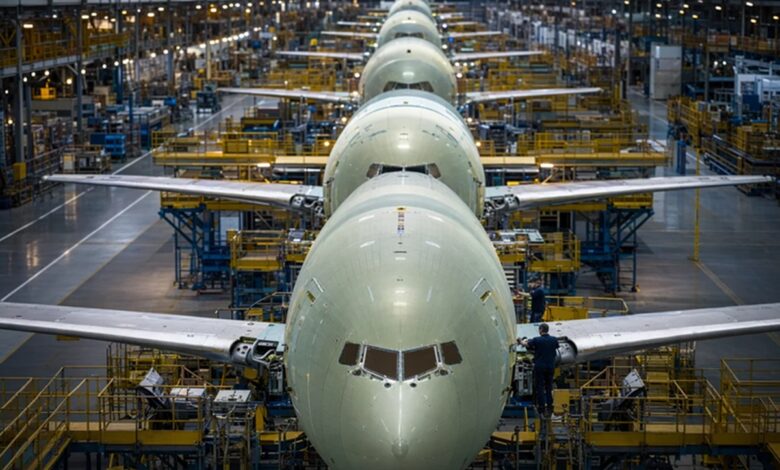
With Global passenger traffic expected to treble over the next 20 years, Boeing anticipates robust long-term growth in the aviation sector despite short-term geopolitical and supply chain challenges. In order to meet growing demand and update current fleets, airlines and cargo operators would need 43,625 new commercial aircraft between 2026 and 2045, according to the company’s 2026 Commercial Market Outlook (CMO), which was published ahead of the Farnborough International Airshow.
Only a few weeks have passed since Airbus published its own 2026–2045 Global Market Forecast, which projected demand for 42,060 new passenger and freighter aircraft during that time. Although the two manufacturers’ delivery projections are marginally different, they both indicate that global aviation will continue to grow over the long term due to increased passenger demand, economic expansion, and fleet modernisation.
By 2045, Boeing predicts that the world’s commercial fleet would have grown by almost 80% to over 50,000 aircraft. In order to meet airline efficiency and sustainability goals, about half of all anticipated deliveries will replace older aircraft with more fuel-efficient models.
“Airlines are quickly adapting to manage near-term industry constraints while demand for air travel remains resilient,” stated Brad McMullen, Senior Vice President, Commercial Sales and Marketing, Boeing. The need to expand and update the global fleet is being driven by this need, highlighting the significance of new, fuel-efficient aircraft that will become more and more important in linking people and economies worldwide.
While some long-haul travel has been temporarily impacted by geopolitical developments, like as tensions in the Middle East, Boeing observed that passengers are typically changing locations and itineraries rather than completely cancelling flights. The business projects that between 2026 and 2045, air travel will double due to an average yearly growth rate of 4% in worldwide passenger traffic.
The report also shows how airline strategy are evolving, with low-cost airlines continuing to expand quickly throughout emerging regions while carriers are increasing their premium services in mature markets. Since 2015, airlines have expanded their global networks by about 30% and provided passengers with additional direct connection by adding roughly 5,500 new airport pairings.
With 33,545 deliveries, single-aisle aircraft will make up the majority of future demand, followed by 7,715 widebody aircraft, 1,435 regional aircraft, and 930 freighters. About 45% of supplies are anticipated to come from mature markets, with the remaining 55% coming from growing and transitioning areas like China, the Middle East, South and Southeast Asia, Latin America, and Africa.
Additionally, Boeing projects that the air cargo industry will continue to develop, with traffic predicted to increase by 3.7% per year through 2045 due to cross-border e-commerce, urgent shipments, and robust global supply chains. Despite continuous market interruptions, international freighter capacity has already expanded by 5% thus far in 2026.
Boeing projects that the world’s fleet will have more than 36,000 single-aisle aircraft, more than 8,000 widebody aircraft, and a need for more than 2,900 production and converted freighters by 2045, demonstrating the industry’s long-term faith in the expansion of international aviation.