

PM Modi Inaugurates Bhogapuram Airport.
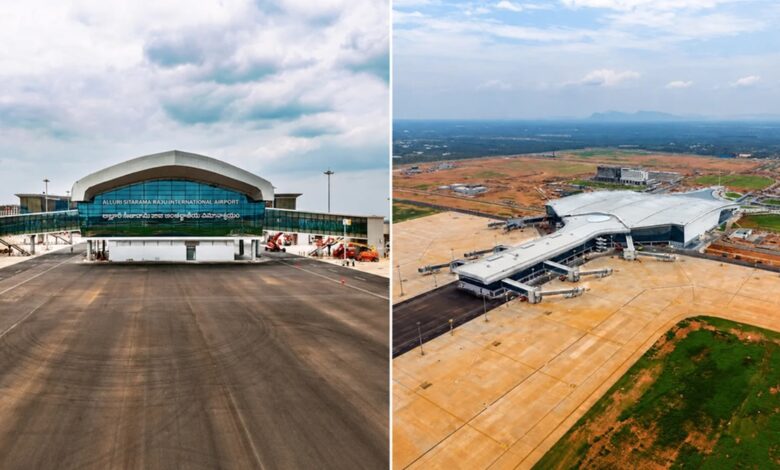
The Alluri Sitarama Raju International Airport in Bhogapuram, close to Visakhapatnam, was inaugurated by Prime Minister Narendra Modi, marking an important milestone in India’s aviation infrastructure and boosting the connectivity and economic development of Andhra Pradesh. The new airport will start operating commercial flights on August 17, 2026.
The 2,200-acre airport was constructed using the Public-Private Partnership (PPP) model on a Design, Build, Finance, Operate, and Transfer (DBFOT) basis by GMR Visakhapatnam International Airport Limited (GVIAL), a division of GMR Aero. The project was finished several months ahead of time, demonstrating how well one of India’s major greenfield airport constructions was carried out.
The airport’s strategic location is anticipated to revolutionise connectivity throughout southern Odisha, the coastline region of the state, and northern Andhra Pradesh. Designed to accommodate the significant industrial and economic expansion planned for the Visakhapatnam region, including data centers, manufacturing, logistics, and technology parks, it is positioned as the “Gateway of the East” and is intended to promote tourism, trade, cargo, exports, and investment.
The Bhogapuram airport is the eighth airport in the global portfolio of GMR Airports Limited and its third greenfield airport. Inspired by the indigenous Parava Meenu (flying fish), the integrated passenger terminal is 77,342 square meters in size and can initially accommodate six million people per year. Future extension of the terminal is planned, allowing it to handle over 40 million passengers annually.
Self-service check-in kiosks, e-gates, sophisticated baggage handling systems, DigiYatra integration, and AI-enabled passenger services are all characteristics of this next-generation aviation hub. Additionally, it has an Airport Predictive Operations Center (APOC) for effective airport administration and real-time monitoring. A 3,800-meter Code 4E runway, parallel taxiways, rapid departure taxiways, eighteen aircraft stands, and a 55-meter Air Traffic Control tower are all part of the airside infrastructure.
The airport’s architecture incorporates sustainability with a 5 MW solar power plant, substantial natural lighting, green construction standards, and energy-efficient technologies. In addition to aviation, the development creates a comprehensive ecosystem for business, logistics, training, and aerospace-related businesses with its 154-acre Aerocity, residential township, industrial zone, and aerospace hub.
According to GMR Airports officials, the project reflects a long-term strategy to provide a top-notch passenger experience while opening doors in the tourist, trade, cargo, and aviation-related businesses. The airport is anticipated to become a significant entry point for India’s eastern corridor, boosting employment, investment, and regional prosperity while bolstering the nation’s aviation sector, they continued.